You Gotta See How Athens Turns Streets Into Soul
Walking through Athens, I didn’t just see a city—I felt its pulse in every alley, square, and sunlit corner. It’s not just about ancient ruins; it’s how modern life breathes through the urban fabric. From open-air galleries to hidden courtyards, Athens redefines city space with raw charm. This is urban energy at its most authentic—alive, unexpected, and impossible to ignore. The city doesn’t perform for visitors; it simply lives, loudly and lovingly, in layers of history, color, and human connection. To walk its streets is to witness a metropolis that values soul over symmetry, resilience over polish, and community over spectacle.
First Impressions: Chaos with Character
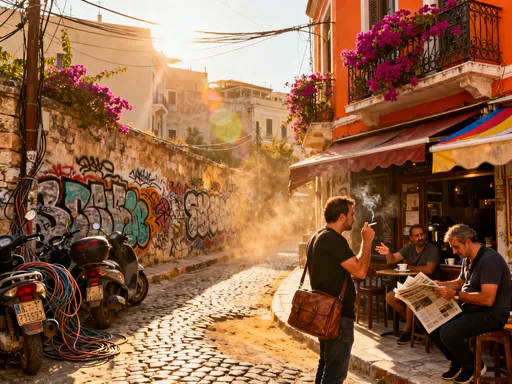
Athens does not greet you with grand boulevards or manicured plazas. Instead, it unfolds in a cascade of sensory impressions—sun-bleached stucco walls, the scent of jasmine drifting from unseen gardens, the rhythmic clatter of espresso cups on marble tables. The city’s first embrace is one of controlled disorder, a mosaic of textures and sounds that might feel overwhelming at first but soon reveals a deeper harmony. In neighborhoods like Psyrri and Koukaki, narrow lanes wind unpredictably, flanked by buildings that lean slightly, as if sharing secrets. Graffiti is not erased here; it’s layered, evolving like a living archive of public sentiment. Bougainvillea spills over wrought-iron balconies, softening the urban grit with bursts of magenta and violet.
This is not a city designed for Instagram perfection. It resists the sanitized uniformity of many European capitals. There are no sweeping renovations that erase history in the name of modernity. Instead, Athens wears its past openly—cracked facades, peeling paint, and weathered stone are not signs of neglect but badges of endurance. The city has weathered economic hardship, political shifts, and social transformation, and its streets reflect that journey. Yet, within this apparent chaos lies a deep sense of identity. Locals move through the city with ease, navigating its irregularities as if they were written into their DNA. The disorder is not random; it’s rhythmic, almost musical in its unpredictability.
What strikes the observant traveler is how functional this chaos truly is. The city works—buses weave through tight corners, vendors set up carts in the same spots for decades, children play in shaded doorways while elders sip coffee nearby. This is urban life in its most organic form, where infrastructure adapts to people rather than the other way around. The absence of rigid order does not mean absence of care. On the contrary, every chipped wall, every hand-painted sign, every improvised flowerpot on a windowsill speaks of a deep, quiet pride. Athens is not trying to be somewhere else. It is, unapologetically, itself.
The Heartbeat of Public Spaces: Squares That Breathe
If Athens has a nervous system, its squares are the synapses—vibrant, interconnected, and constantly active. Syntagma Square, anchored by the Hellenic Parliament, is perhaps the most iconic. By day, it swarms with tourists photographing the evzone guards in their pleated kilts; by evening, it transforms into a gathering point for political rallies, impromptu protests, or simply a place to sit and watch the world pass by. Unlike the sterile plazas of some capital cities, Syntagma is never still. It pulses with a civic energy that feels both urgent and enduring. The marble steps around the parliament building double as benches, and it’s common to see people of all ages resting there, reading, talking, or dozing in the sun.
Monastiraki Square, just a short walk away, offers a different rhythm. Here, the air hums with commerce and music. Street vendors sell everything from leather sandals to handmade jewelry, while buskers strum bouzoukis or play jazz on saxophones. The flea market spills into surrounding alleys, inviting exploration. This is a space of exchange—not just of goods, but of cultures, languages, and stories. Travelers from every continent mingle with Athenian shoppers, creating a human tapestry that feels both global and deeply local. The square’s irregular shape, defined by ancient ruins and bustling storefronts, encourages lingering rather than passing through. There are no strict pathways or enforced rules—just an organic flow of movement and interaction.
Then there is Exarchia, a neighborhood and square that defies easy categorization. Known for its radical politics and intellectual history, Exarchia Square is a place of resistance and refuge. Cafés with mismatched furniture host debates on philosophy, art, and social justice. Street art here is more confrontational, often carrying messages about autonomy, anti-capitalism, and human rights. Yet, amid the intensity, there is warmth. Children play football on the cobblestones, and neighbors share meals at outdoor tables. The square does not cater to tourists, and that authenticity is precisely what makes it compelling. These three squares—Syntagma, Monastiraki, Exarchia—represent different facets of Athens, but they share a common trait: they are designed not for transit, but for presence. They invite you to stay, to engage, to become part of the city’s ongoing story.
Street Art as Urban Dialogue
In many cities, street art is either celebrated in curated districts or erased as vandalism. In Athens, it is neither. It is conversation. Walk through Metaxourgeio or Kerameikos, and you’ll find walls transformed into open-air galleries, not by decree, but by collective will. Murals depict everything from mythological figures reimagined in modern contexts to poignant portraits of refugees, workers, and everyday heroes. One wall might carry a bold political slogan in Greek and English; another might show a child releasing a paper boat into a painted sea. These are not decorations. They are statements, questions, and sometimes, elegies.
What makes Athens’ street art so powerful is its impermanence and responsiveness. A mural might appear overnight in response to a news event, only to be painted over weeks later by another artist offering a counterpoint. This constant evolution turns the city into a living dialogue, where visual language replaces debate stages. Artists do not need permission—they need only a spray can and a message. Some works are technically intricate, resembling fine art; others are raw and immediate, their power lying in their urgency. The lack of institutional control does not diminish their value—in fact, it enhances it. This is art that belongs to the people, for the people.
Unlike museum exhibitions that require tickets and silence, Athens’ street art demands nothing but attention. You don’t need to be an art critic to engage with it. A grandmother walking her dog, a student on a scooter, a tourist with a map—each can pause, reflect, and respond in their own way. Some murals have become landmarks in their own right, guiding locals and visitors alike through neighborhoods that might otherwise feel disorienting. The art doesn’t beautify the city so much as reveal its soul—its struggles, hopes, and contradictions. In a world where public discourse often feels fractured, Athens shows how walls can unite rather than divide, when used not to separate, but to speak.
Green Oases in the Concrete Maze
Given its reputation for heat and density, Athens might seem an unlikely candidate for urban greenery. Yet, the city is threaded with green spaces that offer both respite and revelation. The National Garden, located just behind the Hellenic Parliament, is a 15-hectare sanctuary of shade, fragrance, and birdcall. Within its gates, peacocks strut across gravel paths, turtles bask in small ponds, and citrus trees bloom in spring. Locals come here to escape the summer sun, read under eucalyptus trees, or walk their dogs on shaded lanes. Unlike formal gardens that prioritize symmetry, this one feels gently wild—a place where nature is allowed to breathe, even in the heart of the city.
Philopappos Hill, on the southwestern edge of the Acropolis, offers a different kind of green experience. Here, walking trails wind through native shrubs and olive trees, leading to viewpoints that frame the Parthenon in golden light at sunset. Families picnic on stone benches, children chase lizards, and couples stroll hand in hand. The hill is not manicured; its charm lies in its ruggedness, its sense of continuity with the ancient landscape. It feels less like a park and more like a natural extension of the city’s terrain—a reminder that Athens was built not on flat land, but on hills and stone.
More recently, the Stavros Niarchos Foundation Cultural Center has redefined what urban green space can be. Set in southern Athens, this sprawling complex combines a national library, an opera house, and 21 hectares of landscaped parkland. Solar-powered lighting, a man-made canal, and a hill covered in wildflowers demonstrate how sustainability and beauty can coexist. The park is designed for movement—cyclists, runners, and strollers share wide paths, while open lawns host outdoor concerts and yoga classes. What’s remarkable is how seamlessly it integrates with the city’s energy. It doesn’t feel like an escape from Athens; it feels like a celebration of it. These green spaces—old and new—prove that even in a sun-drenched metropolis, nature is not an afterthought. It is a necessity, a source of balance, and a testament to thoughtful urban planning.
Adaptive Reuse: When Old Buildings Find New Lives
Athens has long mastered the art of giving old things new purpose. Rather than demolish, the city often reimagines. This is not the glossy gentrification seen in some global cities, where historic buildings are stripped of character and repurposed for luxury brands. Instead, Athens’ transformations feel organic, even humble. An abandoned factory in Gazi, once part of the city’s industrial spine, now houses music venues, art galleries, and weekend markets. The brick walls remain, the steel beams are exposed, and the soul of the building is preserved even as its function changes.
The Benaki Museum, one of Greece’s most important cultural institutions, exemplifies this ethos. While its main building occupies a neoclassical mansion in central Athens, the museum has expanded into satellite locations—former mansions, townhouses, and even a converted silk factory. Each site retains its architectural identity while serving as a vessel for art, history, and public education. Visitors don’t just see exhibits; they experience them within spaces that tell their own stories. A doorway might still bear the original family crest; a staircase might creak with the weight of decades. These details are not hidden—they are highlighted.
Smaller-scale adaptations are everywhere. A crumbling 1930s apartment building might now host a boutique hotel with minimalist interiors and rooftop views. A ground-floor shop, vacant for years, could reopen as a specialty coffee roaster or a zero-waste grocery. These changes are not imposed from above; they emerge from local initiative, often driven by young entrepreneurs, artists, and families committed to their neighborhoods. The result is a city that evolves without losing its memory. Adaptive reuse in Athens is not about nostalgia—it’s about continuity. It says: we honor the past not by freezing it, but by letting it live on in new forms.
The Rhythm of Daily Life: Cafés, Kiosks, and Shared Moments
To understand Athens, you must slow down. The city reveals itself not in monuments, but in moments. At 8 a.m., a kiosk owner wipes down his counter and switches on the espresso machine. By 8:15, his first customers arrive—office workers in crisp shirts, teachers with satchels, retirees in slippers—each ordering a freddo cappuccino, served over ice in a glass cup. This simple ritual repeats thousands of times a day, a quiet rhythm that binds the city together. These kiosks are more than convenience stores; they are neighborhood anchors, places where news is exchanged, jokes are shared, and friendships are maintained.
In the evenings, the rhythm shifts. Families emerge from apartments, drawn outdoors by the cooler air. Parks fill with children on swings, elders playing backgammon, and teenagers clustered on benches. In neighborhoods like Pangrati and Nea Smyrni, entire households migrate to local squares, bringing folding chairs and snacks. There is no need for entertainment; the act of being together is enough. Balconies, too, become living rooms—strung with fairy lights, draped with laundry, and filled with potted herbs and blooming geraniums. Neighbors call across the street, sharing updates or offering tomatoes from their garden. These interactions are small, but they are the invisible threads that hold the city together.
Even in a metropolis of nearly four million people, Athens manages to feel intimate. Its design supports this closeness. Narrow streets slow movement, encouraging conversation. Courtyards hidden behind unassuming doors offer surprise oases. Small plazas, tucked between buildings, become stages for impromptu gatherings. There is no grand master plan for these moments—they emerge naturally from a culture that values connection over convenience. In a world where urban life often feels isolating, Athens offers a different model: one where the city is not just a place to live, but a place to belong.
Why Athens Redefines Urban Living
Athens does not offer perfection. It offers presence. In an era when many cities strive to be sleek, efficient, and globally branded, Athens stands apart. It is dense, layered, and sometimes messy—but also deeply human. Its strength lies not in what it hides, but in what it reveals: the cracks, the colors, the conversations, the contradictions. It teaches that urban life thrives not on flawless design, but on authenticity, adaptability, and community.
For travelers, this means an experience that is immersive rather than performative. You won’t find staged reenactments or sanitized historic districts. Instead, you’ll encounter a city that asks you to participate—to wander without a map, to sip coffee at a corner kiosk, to stand in awe beneath a mural as powerful as any museum painting. Athens doesn’t need to impress you. It simply invites you to see the world differently.
And perhaps that is its greatest gift. In a time when so many cities feel interchangeable—dominated by chain stores, identical high-rises, and tourist zones—Athens remains fiercely, beautifully itself. It proves that soul can exist in the cracks, that history can be lived rather than displayed, and that a city’s true beauty lies not in its monuments, but in its people. To walk its streets is to remember that urban life, at its best, is not about control, but about connection. It is not about hiding imperfection, but about transforming it into art. And in that transformation, Athens doesn’t just survive—it sings.